


Page 10 - The Indian EYE 042426
P. 10
OPINION                                                                  APRIL 24, 2026    |  The Indian Eye 10


                 EXHAUSTION AND ENDURANCE:


                        Contrasting US–Russian Defense


         Industrial Resilience and Lessons for India


         Following the end of the Cold War and the swift victory in the Gulf War, decision-makers increasingly

         assumed that future conflicts would be short, decisive and heavily dependent on advanced technology


                 RAJNEESH SINGH

              he  ongoing  war  between  the
              United States (US) and Is-
        Trael with Iran, code-named
        Operation Epic Fury by the US, has
        exposed  significant  weaknesses  in
        the US defense manufacturing base,
        leading  to  growing  concerns  about
        sustainability  in  a  protracted  war.
        While the US retains overwhelming
        technological  superiority,  its  ability
        to sustain high-intensity operations is
        increasingly constrained by industrial
        and supply chain limitations.
            The US armed forces have ex-
        pended certain advanced munitions
        at an extremely rapid rate due to the
        high tempo of operations, especially
        in the initial days of the war. Accord-
        ing to a report presented to mem-
        bers of the US Congress, the US is
        estimated to have expended approx-
        imately US$ 5.6 billion worth of mu-
        nitions within the first 48 hours of its
        military operations against Iran.
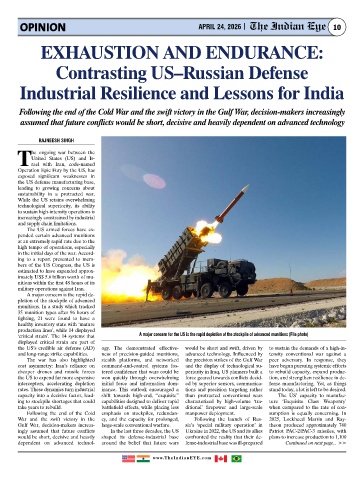
            A major concern is the rapid de-
        pletion of the stockpile of advanced
        munitions. In a study which tracked
        35 munition types after 96 hours of
        fighting,  21  were  found  to  have  a
        healthy inventory state with ‘mature
        production lines’, while 14 displayed
        ‘critical strain’. The 14 systems that            A major concern for the US is the rapid depletion of the stockpile of advanced munitions (File photo)
        displayed critical strain are part of
        the  US’s  credible  air  defense  (AD)   ogy. The demonstrated effective-  would be short and swift, driven by   to sustain the demands of a high-in-
        and long-range strike capabilities.  ness of precision-guided munitions,   advanced technology. Influenced by   tensity conventional war against a
            The war has also highlighted   stealth platforms, and networked   the precision strikes of the Gulf War   peer adversary. In response, they
        cost asymmetry: Iran’s reliance on   command-and-control systems fos-  and the display of technological su-  have begun pursuing systemic efforts
        cheaper  drones  and  missile  forces   tered confidence that wars could be   periority in Iraq, US planners built a   to rebuild capacity, expand produc-
        the US to expend far more expensive   won  quickly  through  overwhelming   force geared towards conflicts decid-  tion, and strengthen resilience in de-
        interceptors,  accelerating  depletion   initial force and information dom-  ed by superior sensors, communica-  fense manufacturing. Yet, as things
        rates. These dynamics turn industrial   inance. This outlook encouraged a   tions and precision targeting rather   stand today, a lot is left to be desired.
        capacity into a decisive factor, lead-  shift  towards  high-end,  “exquisite”   than  protracted  conventional  wars   The US’ capacity to manufac-
        ing to stockpile shortages that could   capabilities designed to deliver rapid   characterized  by  high-volume  ‘tra-  ture ‘Exquisite Class Weaponry’
        take years to rebuild.            battlefield effects, while placing less   ditional’  firepower  and  large-scale   when compared to the rate of con-
            Following the end of the Cold   emphasis on stockpiles, redundan-  manpower deployment.           sumption is  equally  concerning. In
        War and the swift victory in the   cy, and the capacity for prolonged,   Following the launch of Rus-  2025,  Lockheed  Martin  and  Ray-
        Gulf  War,  decision-makers  increas-  large-scale conventional warfare.  sia’s ‘special military operation’ in   theon  produced  approximately  740
        ingly  assumed  that  future  conflicts   In the last three decades, the US   Ukraine in 2022, the US and its allies   Patriot PAC-2/PAC-3 missiles, with
        would be short, decisive and heavily   shaped  its  defense-industrial  base   confronted the reality that their de-  plans to increase production to 1,100
        dependent on advanced technol-    around  the  belief  that  future  wars   fense-industrial base was ill-prepared   Continued on next page... >>


                                                               www.TheIndianEYE.com

