


Page 5 - The Indian EYE 041726
P. 5
COVER STORY                                                              APRIL 17, 2026    |  The Indian Eye                    5


        lacked institutional support, adding                                                                  reach among women voters, a cru-
        that the proposed 33 per cent res-                                                                    cial and growing electoral segment.
        ervation would encourage greater                                                                      By pushing a long-pending reform,
        participation in governance. “From                                                                    the government can claim decisive
        managing households to leading in-                                                                    leadership where  previous regimes
        stitutions, women have proven their                                                                   struggled. The bill also aligns with its
        capability in every field,” she said.                                                                 broader “Nari Shakti” narrative, re-
                                                                                                              inforcing political messaging ahead
        Similarly, former Himachal                                                                            of elections. Additionally, it can help
                                                                                                              consolidate support across regions
        Pradesh Congress Committee                                                                            and social groups, while putting the

        chief Pratibha Singh expressed                                                                        opposition on the defensive over past
                                                                                                              delays in implementing women’s res-
        optimism that the bill would                                                                          ervation.
                                                                                                                  Several  countries  have  imple-
        “open doors for more women                                                                            mented reservation or quota systems
        to enter politics,” reflecting                                                                        to increase women’s representation

        a broader consensus that the                                                                          in parliament. Nations like Rwanda
                                                                                                              lead globally, with over 60% wom-
        principle of reservation enjoys                                                                       en in its lower house due to consti-
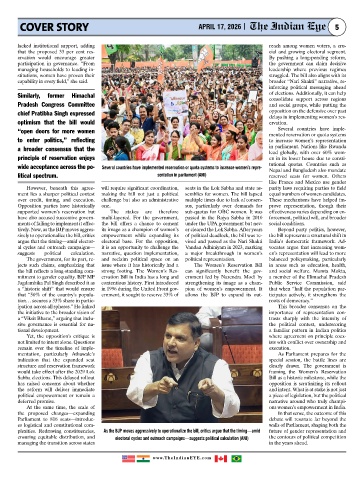
        wide acceptance across the po-    Several countries have implemented reservation or quota systems to increase women’s repre-  tutional quotas. Countries such as
                                                                                                              Nepal and Bangladesh also mandate
        litical spectrum.                                        sentation in parliament (ANI)                reserved seats for women. Others
                                                                                                              like France and Mexico use gender
            However, beneath this agree-  will require significant coordination,   seats in the Lok Sabha and state as-  parity laws requiring parties to field
        ment lies a sharper political contest   making the bill not just a political   semblies for women. The bill lapsed   equal numbers of women candidates.
        over  credit,  timing,  and  execution.   challenge but also an administrative   multiple times due to lack of consen-  These mechanisms have helped im-
        Opposition parties have historically   one.                         sus, particularly over demands for   prove representation, though their
        supported  women’s  reservation  but   The  stakes  are  therefore  sub-quotas for OBC women. It was   effectiveness varies depending on en-
        have also accused successive govern-  multi-layered. For the government,   passed in the Rajya Sabha in 2010   forcement, political will, and broader
        ments of failing to implement it effec-  the bill offers a chance to cement   under the UPA government but nev-  social conditions.
        tively. Now, as the BJP moves aggres-  its image as a champion of women’s   er cleared the Lok Sabha. After years   Beyond party politics, however,
        sively to operationalize the bill, critics   empowerment while expanding its   of political deadlock, the bill was re-  the bill represents a structural shift in
        argue that the timing—amid elector-  electoral base. For the opposition,   vived and passed as the Nari Shakti   India’s democratic framework. Ad-
        al cycles and outreach campaigns—  it is an opportunity to challenge the   Vandan Adhiniyam in 2023, marking   vocates argue that increasing wom-
        suggests   political  calculation.  narrative, question implementation,   a major breakthrough in women’s   en’s representation will lead to more
            The government, for its part, re-  and reclaim political space on an   political representation.  balanced policymaking, particularly
        jects such claims, emphasizing that   issue where it has historically had a   The Women’s Reservation Bill   in areas such as education, health,
        the bill reflects a long-standing com-  strong footing. The Women’s Res-  can  significantly  benefit  the  gov-  and social welfare. Mamta Mokta,
        mitment to gender equality. BJP MP   ervation Bill in India has a long and   ernment led by Narendra Modi by   a member of the Himachal Pradesh
        Jagdambika Pal Singh described it as   contentious history. First introduced   strengthening its image as a cham-  Public Service Commission, said
        a  “historic  shift”  that  would  ensure   in 1996 during the United Front gov-  pion of women’s empowerment. It   that when “half the population par-
        that “50% of the country’s popula-  ernment, it sought to reserve 33% of   allows  the  BJP  to  expand  its  out-  ticipates actively, it strengthens the
        tion… secures a 33% share in partic-                                                                  roots of democracy.”
        ipation across all spheres.” He linked                                                                    This broader consensus on the
        the initiative to the broader vision of                                                               importance of representation con-
        a “Viksit Bharat,” arguing that inclu-                                                                trasts sharply with the intensity of
        sive governance is essential for na-                                                                  the political contest, underscoring
        tional development.                                                                                   a familiar pattern in Indian politics
            Yet, the opposition’s critique is                                                                 where agreement on principle coex-
        not limited to intent alone. Questions                                                                ists with conflict over ownership and
        remain over the timeline of imple-                                                                    execution.
        mentation, particularly Athawale’s                                                                        As  Parliament prepares for the
        indication that the expanded seat                                                                     special session, the battle lines are
        structure and reservation framework                                                                   clearly  drawn.  The  government  is
        would take effect after the 2029 Lok                                                                  framing the Women’s Reservation
        Sabha elections. This delayed rollout                                                                 Bill as a historic milestone, while the
        has raised concerns about whether                                                                     opposition is scrutinizing its rollout
        the reform will deliver immediate                                                                     and intent. What is at stake is not just
        political empowerment or remain a                                                                     a piece of legislation, but the political
        deferred promise.                                                                                     narrative around who truly champi-
            At the same time, the scale of                                                                    ons women’s empowerment in India.
        the proposed changes—expanding                                                                            In that sense, the outcome of this
        Parliament to 816 seats—introduc-                                                                     debate will resonate far beyond the
        es logistical and constitutional com-                                                                 walls of Parliament, shaping both the
        plexities. Redrawing constituencies,   As the BJP moves aggressively to operationalize the bill, critics argue that the timing—amid   future of gender representation and
        ensuring equitable distribution, and    electoral cycles and outreach campaigns—suggests political calculation (ANI)  the contours of political competition
        managing the transition across states                                                                 in the years ahead.


                                                               www.TheIndianEYE.com

