


Page 24 - The Indian EYE 010226
P. 24
JANUARY 02, 2026      |  The Indian Eye 24


                                           BUSINESS LEADERS OF 2025


                     Vembu and the Reinvention of


               Leadership in Indian Technology


           In 2025, Sridhar Vembu stepped away from the corner office to shape India’s tech future


                                       from the laboratory, the village, and the long view.

           n a year when Indian technology was consumed by
           the hype and anxiety of artificial intelligence, Sri-
        Idhar Vembu chose a contrarian path. In January
        2025, he stepped down as CEO of Zoho Corporation
        to take on the role of Chief Scientist, signaling a deci-
        sive shift—from managing scale to shaping direction.
        The move did not mark a retreat from leadership; in-
        stead, it redefined it. Vembu emerged in 2025 as one
        of India’s most original business thinkers, blending
        deep technology, rural economics, and institution-
        al restraint at a time of global technological excess.
            His new role placed him at the heart of Zoho’s
        research and development agenda. Freed from daily
        executive oversight, Vembu focused on building long-
        term technological capability, particularly in artifi-
        cial intelligence. At ZohoDay 2025, he unveiled “Zia
        Agents,” a contextual AI framework designed not as
        a generic chatbot, but as a system embedded deeply
        within enterprise workflows. Vembu revealed that
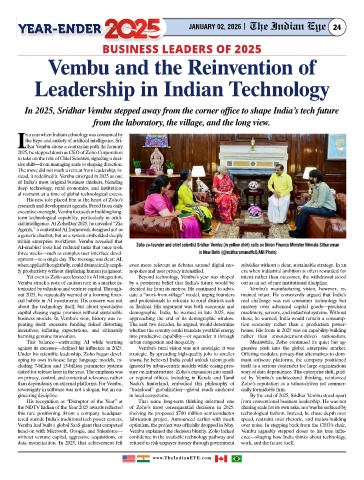
        AI-enabled tools had reduced tasks that once took   Zoho co-founder and chief scientist Sridhar Vembu (in yellow shirt) calls on Union Finance Minister Nirmala Sitharaman
        three weeks—such as complex user interface devel-                         in New Delhi (@nsitharamanoffcX/ANI Photo)
        opment—to a single day. The message was clear: AI,
        when applied thoughtfully, could dramatically ampli-  even more relevant as debates around digital mo-  subsidies without a clear, sustainable strategy. In an
        fy productivity without displacing human judgment.  nopolies and user privacy intensified.  era when industrial ambition is often rewarded for
            Yet even as Zoho accelerated its AI integration,   Beyond technology, Vembu’s year was shaped   intent rather than outcomes, the withdrawal stood
        Vembu struck a note of caution rare in a market in-  by a persistent belief that India’s future would be   out as an act of rare institutional discipline.
        toxicated by valuation and venture capital. Through-  decided far from its metros. He continued to advo-  Vembu’s manufacturing vision, however, re-
        out 2025, he repeatedly warned of a looming finan-  cate a “work-from-village” model, urging founders   mained intact. He consistently argued that India’s
        cial bubble in AI investments. His concern was not   and professionals to relocate to rural districts such   real challenge was not consumer technology but
        about  the technology  itself,  but  about  speculative   as Tenkasi. His argument was both economic and   mastery over advanced capital goods—precision
        capital chasing vague promises without sustainable   demographic. India, he warned in late 2025, was   machinery, sensors, and industrial systems. Without
        business models. In Vembu’s view, history was re-  approaching the end of its demographic window.   these, he warned, India would remain a consump-
        peating itself: excessive funding risked distorting   The next two decades, he argued, would determine   tion economy rather than a production power-
        incentives,  inflating  expectations,  and  ultimately   whether the country could translate youthful energy   house. His focus in 2025 was on capability-building
        harming genuine innovation.                  into productive capability—or squander it through   rather than announcement-driven nationalism.
            This balance—embracing AI while warning   urban congestion and inequality.                Meanwhile, Zoho continued its quiet but ag-
        against its excesses—defined his influence in 2025.   Vembu’s rural vision was not nostalgic; it was   gressive push into the global enterprise market.
        Under his scientific leadership, Zoho began devel-  strategic. By spreading high-quality jobs to smaller   Offering modular, privacy-first alternatives to dom-
        oping its own in-house large language models, in-  towns, he believed India could unlock talent pools   inant software platforms, the company positioned
        cluding 7-billion and 13-billion parameter systems   ignored by urban-centric models while easing pres-  itself as a serious contender for large organizations
        slated for release later in the year. The emphasis was   sure on infrastructure. Zoho’s expansion into small-  wary of data dependence. This enterprise shift, guid-
        on privacy, control, and contextual relevance, rather   er  regional  offices,  including  in  Kerala  and  Tamil   ed by Vembu’s architectural thinking, reinforced
        than dependency on external platforms. For Vembu,   Nadu’s hinterland, embodied this philosophy of   Zoho’s reputation as a values-driven yet commer-
        sovereignty in software was not a slogan, but an en-  “translocal”  globalization—global  reach  anchored   cially formidable firm.
        gineering discipline.                        in local ecosystems.                             By the end of 2025, Sridhar Vembu stood apart
            His recognition as “Disruptor of the Year” at   That same long-term thinking informed one   from conventional business leadership. He was not
        the NDTV Indian of the Year 2025 awards reflected   of Zoho’s most consequential decisions in 2025:   chasing scale for its own sake, nor was he seduced by
        this  rare  positioning.  From  a  company  headquar-  shelving its proposed $700 million semiconductor   technological fashion. Instead, he chose depth over
        tered outside India’s traditional tech power centers,   fabrication project. Announced earlier with much   speed, restraint over rhetoric, and nation-building
        Vembu had built a global SaaS giant that competed   optimism, the project was officially dropped in May.   over noise. In stepping back from the CEO’s chair,
        head-on with Microsoft, Google, and Salesforce—  Vembu explained the decision bluntly. Zoho lacked   Vembu  arguably  stepped  closer  to  his  true  influ-
        without venture capital, aggressive acquisitions, or   confidence in the available technology pathway and   ence—shaping how India thinks about technology,
        data monetization. In 2025, that achievement felt   refused to risk taxpayer money through government   work, and the future itself.


                                                               www.TheIndianEYE.com

