


Page 5 - The Indian EYE 121925
P. 5
COVER STORY                                                        DECEMBER 19, 2025       |  The Indian Eye                    5


        Rather than closure, it deepened                                                                      echoed the need to prioritize pollu-
        ideological trench lines.                                                                             tion alongside issues like unemploy-
        Elections: democracy in dispute                                                                       ment and public safety.
                                                                                                                  Yet the pollution debate strug-
           f the Vande Mataram debate                                                                         gled to sustain momentum. Over-
           was emotional, the discussion on                                                                   shadowed by louder confrontations
        Ielectoral reforms was incendiary.                                                                    on nationalism and elections, it high-
        Leader of Opposition Rahul Gandhi                                                                     lighted a recurring pattern in Parlia-
        used the floor of Parliament to reit-                                                                 ment: consensus issues often receive
        erate his allegation of “vote chori,”                                                                 less time and political energy than
        accusing the Election Commission                                                                      polarizing ones.
        of colluding with the ruling party to                                                                        The larger pattern
        shape electoral outcomes.
            Gandhi’s central charge focused                                                                         iewed together, the three
        on recent changes to the law gov-                                                                           debates reveal the  political
        erning the appointment of Election                                                                    Vdynamics shaping this, Parlia-
        Commissioners  —  specifically  the                                                                   ment. Cultural symbolism energizes
        removal of the Chief Justice of India                                                                 bases but hardens divisions. Elec-
        from the selection committee  and                                                                     toral  disputes  reflect  deep  mistrust
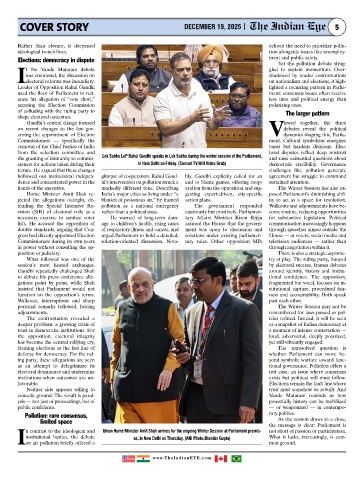
        the granting of immunity to commis-  Lok Sabha LoP Rahul Gandhi speaks in Lok Sabha during the winter session of the Parliament,   and raise existential questions about
        sioners for actions taken during their           in New Delhi on Friday. (Sansad TV/ANI Video Grab)   democratic credibility. Governance
        tenure. He argued that these changes                                                                  challenges like pollution generate
        hollowed out institutional indepen-  glimpse of cooperation. Rahul Gand-  bly, Gandhi explicitly called for an   agreement but struggle to command
        dence and concentrated power in the   hi’s intervention on pollution struck a   end to blame games, offering coop-  sustained attention.
        hands of the executive.           markedly different tone. Describing   eration from the opposition and sug-  The Winter Session has also ex-
            Home Minister Amit Shah re-   India’s major cities as living under “a   gesting  expert-driven,  city-specific   posed Parliament’s diminishing abil-
        jected the allegations outright, de-  blanket of poisonous air,” he framed   action plans.            ity to act as a space for resolution.
        fending the Special Intensive Re-  pollution as a national emergency    The government responded      Walkouts and adjournments have be-
        vision (SIR) of electoral rolls as a   rather than a political issue.  cautiously but positively. Parliamen-  come routine, reducing opportunities
        necessary exercise to sanitize voter   He  warned  of  long-term  dam-  tary Affairs Minister Kiren Rijiju   for substantive legislation. Political
        lists. He accused the opposition of   age to children’s health, rising cases   assured the House that the govern-  communication increasingly happens
        double standards, arguing that Con-  of respiratory illness and cancer, and   ment  was  open  to  discussion  and   through speeches aimed outside the
        gress had directly appointed Election   urged Parliament to hold a detailed,   solutions under existing parliamen-  House — at voters, social media and
        Commissioners during its own years   solution-oriented discussion. Nota-  tary rules. Other opposition MPs   television audiences — rather than
        in power without consulting the op-                                                                   through negotiation within it.
        position or judiciary.                                                                                    There is also a strategic asymme-
            What followed was one of the                                                                      try at play. The ruling party, buoyed
        session’s most heated exchanges.                                                                      by electoral success, frames debates
        Gandhi repeatedly challenged Shah                                                                     around identity, history and institu-
        to debate his press conference alle-                                                                  tional  confidence.  The  opposition,
        gations point by point, while Shah                                                                    fragmented but vocal, focuses on in-
        insisted that Parliament would not                                                                    stitutional  capture,  procedural  fair-
        function on the opposition’s terms.                                                                   ness and accountability. Both speak
        Walkouts, interruptions and sharp                                                                     past each other.
        personal remarks followed, forcing                                                                        The Winter Session may not be
        adjournments.                                                                                         remembered for laws passed or pol-
            The confrontation revealed a                                                                      icies refined. Instead, it will be seen
        deeper problem: a growing crisis of                                                                   as a snapshot of Indian democracy at
        trust in democratic institutions. For                                                                 a moment of intense contestation —
        the  opposition, electoral  integrity                                                                 loud, adversarial, deeply polarized,
        has become the central rallying cry,                                                                  yet still vibrantly engaged.
        framing elections as the last line of                                                                     The unresolved question is
        defense for democracy. For the rul-                                                                   whether  Parliament  can  move  be-
        ing party, these allegations are seen                                                                 yond symbolic warfare toward func-
        as an attempt to delegitimize its                                                                     tional governance. Pollution offers a
        electoral dominance and undermine                                                                     test case: an issue where consensus
        institutions when outcomes are un-                                                                    exists but political will must follow.
        favorable.                                                                                            Elections remain the fault line where
            Neither side appears willing to                                                                   trust must somehow be rebuilt. And
        concede ground. The result is paral-                                                                  Vande  Mataram reminds  us how
        ysis — not just of proceedings, but of                                                                powerfully history can be mobilized
        public confidence.                                                                                    — or weaponized — in contempo-
           Pollution: rare consensus,                                                                         rary politics.
                 limited space                                                                                    As the session draws to a close,
                                                                                                              the message is clear: Parliament is
           n contrast to the ideological and   Union Home Minister Amit Shah arrives for the ongoing Winter Session at Parliament premis-  not short of passion or participation.
           institutional battles, the debate           es, in New Delhi on Thursday. (ANI Photo/Jitender Gupta)  What  it  lacks,  increasingly,  is  com-
        Ion air pollution briefly offered a                                                                   mon ground.


                                                               www.TheIndianEYE.com

